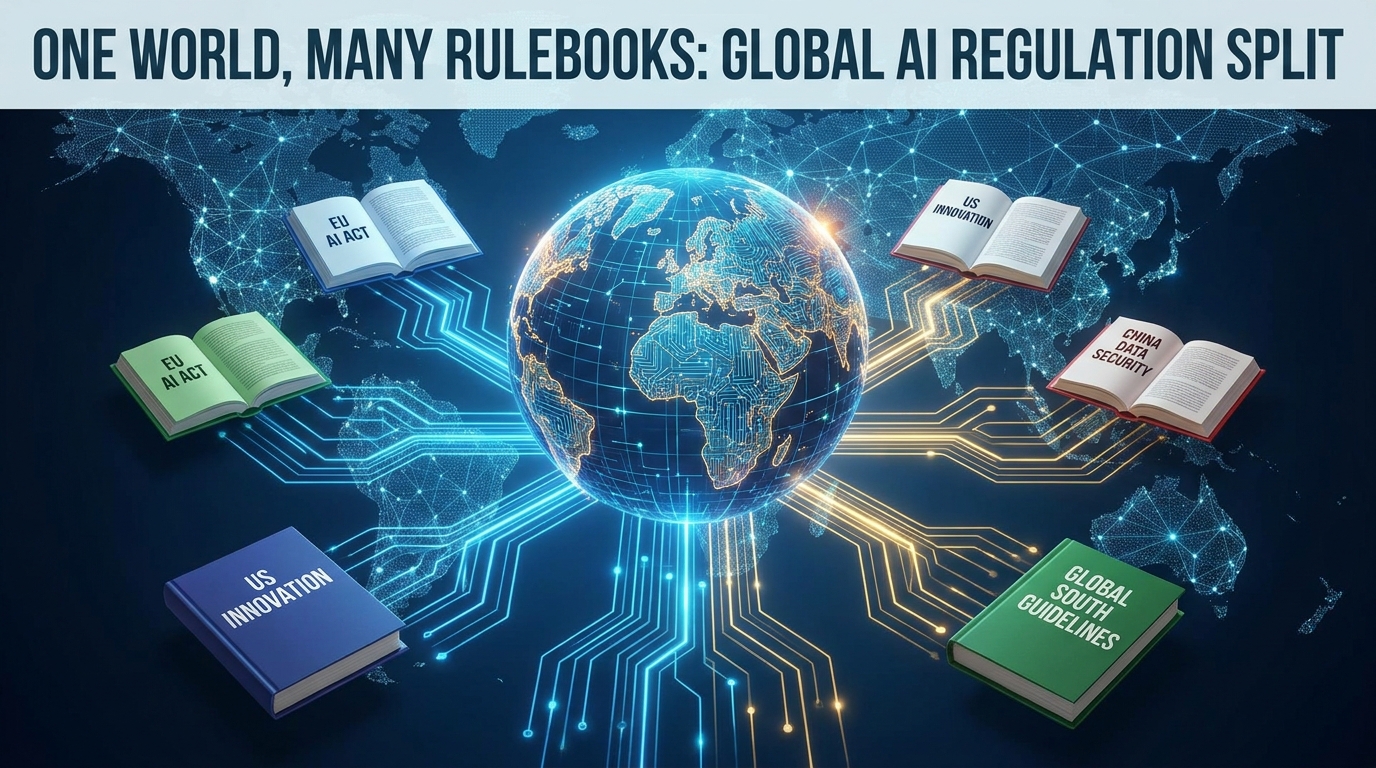
As artificial intelligence races ahead, governments everywhere are scrambling to answer a tricky question: how do you write rules for a technology that’s changing every month? In 2026, the striking thing is that the world isn’t converging on one answer — it’s splitting into very different approaches.
Europe: The Strict Rulemaker
The EU has built what’s shaping up to be the world’s most comprehensive AI law, the AI Act. A major batch of its obligations is set to take effect on 2 August 2026, covering “high-risk” AI systems with requirements like risk assessments, detailed documentation, and human oversight. The penalties are serious — non-compliance can mean fines reaching into the millions or a percentage of a company’s global turnover. Interestingly, even as the deadline approaches, European officials have been debating whether to delay parts of it, wary of holding their own industry back.
The US: Federal vs. State Tug-of-War
The United States is taking a looser, more pro-innovation stance at the national level, framing AI leadership as a matter of strategic priority. But individual states are sprinting ahead with their own rules, creating a patchwork that companies must navigate carefully. The result is an internal push-and-pull over who actually sets the standards.
Different Philosophies Everywhere
- The UK is leaning on flexible, principles-based guidance rather than one big dedicated law, experimenting with regulatory “sandboxes” to test AI safely.
- China is building a tightly controlled, state-visible AI ecosystem with close oversight.
- Japan is betting on trust and cooperation rather than heavy-handed restriction.
Why This Matters
For any company that operates across borders — which is most big tech firms — this fragmented landscape turns compliance into a complex juggling act. A product that’s perfectly legal in one country might run into a wall in another. There’s also a bigger tension underneath it all: technology companies depend on public trust to access data, and that trust evaporates quickly if people feel their information isn’t safe.
Encouragingly, 2026 has also seen the first real attempts at global coordination, with internationally backed efforts to create shared principles for AI governance — though aligning so many different philosophies won’t be easy.
The Takeaway
The way AI gets governed will shape what it’s allowed to do, where, and for whom. For now, the world is writing many rulebooks at once. How they eventually fit together — or clash — will be one of the defining tech stories of the decade.
Should AI be tightly regulated or left free to innovate? We’d love to hear where you land.